
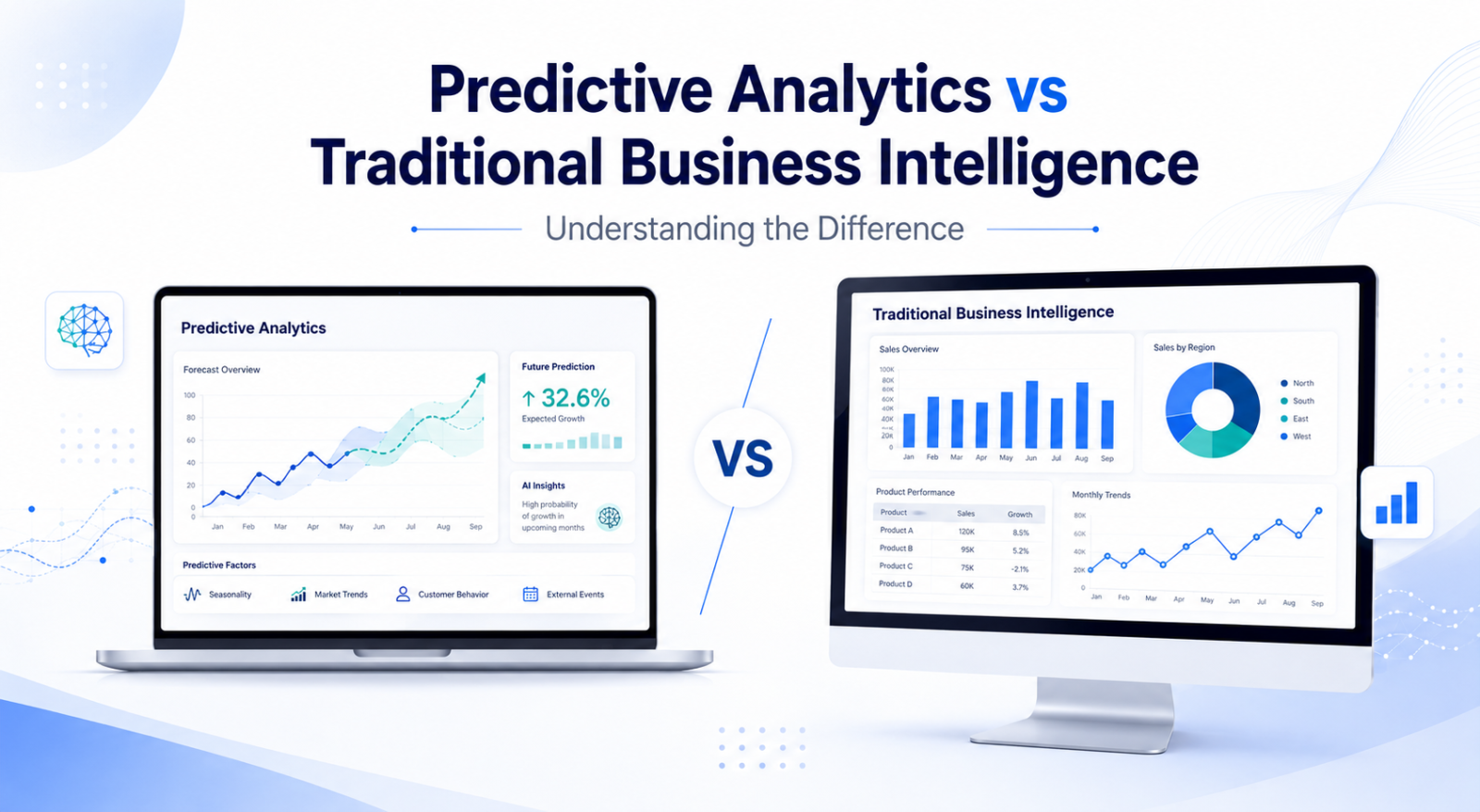

Start with a number that should make you pause. By 2027, half of all business decisions will be augmented or automated by AI agents for decision intelligence. Gartner said that in its Top Data & Analytics Predictions for 2025 and Beyond. Read it again. Half. That isn’t a tweak to how companies run; it’s a different operating model, and it leans hard on prediction instead of plain reporting.
So here’s the thing teams keep getting wrong. They treat Traditional Business Intelligence and Predictive Analytics like one tool wearing two name tags. They’re not. Both feed on data, sure. But one looks backward, and one looks forward, and that single split decides what you buy, what you build, and what you can reasonably expect to get back. Muddle it, and you’ll either overspend on dashboards nobody asked for or sit waiting on a forecast from software that only ever knew how to report.
Let’s sort it out. What each one does, where it earns its keep, how to pick. Useful whether you’re comparing platforms or scoping a predictive analytics project of your own or researching predictive analytics consulting services, understanding these core concepts will help you make more informed business decisions.
Table of Contents
What is Traditional Business Intelligence?
BI, for short. It’s how a company gathers up its historical and current data, makes sense of it, and puts it somewhere people can actually use. The reporting backbone, basically.
Don’t write it off as yesterday’s tech, though. Statista projects the global BI software market will grow by nearly 31% between 2024 and 2029, on its way to $36.35 billion. AI or no AI, businesses still need a trustworthy way to see what’s going on under the hood.
What does BI answer? The everyday stuff. Last month’s sales. Which products moved and which didn’t. Whether that campaign was worth the spend. Whether you’re anywhere near your KPIs. It pulls all of it out of your databases and warehouses and lays it out plainly.
Where BI Earns Its Keep
Executive dashboards. Revenue reports. Financial analysis, inventory checks, customer-service summaries, KPI tracking. The unglamorous gears that keep an organization turning.
One job, really: take what happened, make it legible, hand it to someone who has to make a call.
What is Predictive Analytics?
Now the harder question. Predictive Analytics doesn’t just describe the past; it places a bet on the future. Feed it historical data, point some statistical models and machine learning at it, and it forecasts what’s likely to land next. Less “here’s your report.” More “here’s where this is headed.”
Rather than asking, “What happened?” Predictive Analytics answers questions such as:
- Which customers are likely to churn?
- What will next quarter’s sales look like?
- Which products will experience higher demand?
- Where is fraud most likely to occur?
And this stopped being experimental a while back. Per Gartner’s Top Data & Analytics Predictions for 2025 and Beyond, more than 50% of organizations already use AI tools for automated insights and natural-language queries. Prediction is the floor now, not the ceiling.
Where Predictive Analytics Earns Its Keep
There are several ways to use Predictive Analytics to improve business performance across industries. Organizations commonly use it for sales forecasting, identifying customer churn, predicting product demand, detecting fraud, enabling predictive maintenance, and delivering personalized product recommendations.
By analyzing historical data and patterns, Predictive Analytics helps businesses reduce risks, improve operational efficiency, and make more informed, data-driven decisions.
Predictive Analytics vs Traditional Business Intelligence: Key Differences
Although both approaches rely on business data, their objectives, technologies, and outcomes differ significantly.
| Feature | Traditional Business Intelligence | Predictive Analytics |
| Primary Focus | Historical and current data | Future predictions |
| Purpose | Reporting and monitoring | Forecasting and optimization |
| Technology | Dashboards, reports, KPIs | AI, machine learning, statistical models |
| Insights | Descriptive | Predictive |
| Decision Style | Reactive | Proactive |
Looking Back vs Looking Ahead
BI is your rear-view mirror, showing you the road you already drove and helping you keep tabs on KPIs and trends. Predictive Analytics is the windshield. It takes that same history and throws it forward, so you’re braced for whatever’s coming, the good and the ugly both.
Reactive vs Proactive Decision-Making
BI hands you the numbers after the fact, and then you adjust. Predictive Analytics gets there first, surfacing the risk or the opening early enough that you can still act on it. That timing is basically the whole game.
Reporting vs Forecasting
BI focuses on creating reports, dashboards, and visualizations that summarize business activities.
Predictive Analytics generates forecasts using statistical algorithms and machine learning models, helping organizations make strategic decisions based on expected future trends.
So Which One Do You Actually Need?
Depends entirely on what you’re trying to do.
KPI monitoring, exec reporting, sales reporting? BI, no contest. It was built for tracking performance against your own history.
Demand forecasting, churn prediction, fraud detection? That’s Predictive Analytics’ lane.
Planning past next week? Then, realistically, both. The full picture tends to show up only when you run the two together instead of picking a side.
Conclusion
These two aren’t rivals fighting over the same chair. They’re doing separate jobs inside one data strategy. BI explains what happened, in reports and dashboards and KPIs you can read at a glance. Predictive Analytics uses AI and machine learning to call what’s coming, so you move ahead of the moment instead of cleaning up after it.
Run them together and you’ve covered both ends: a clear account of the past, a grounded sense of the future. Sharper forecasts. Less risk. Calmer planning. That’s the work RipenApps takes on through its predictive analytics services, helping teams forecast with more confidence and act on what the numbers are really saying.
Frequently Asked Questions
1. What is the main difference between Predictive Analytics and Traditional Business Intelligence?
BI sifts your past and present data into reports and dashboards, so you can see the performance that’s already on the books. Predictive Analytics takes that same data, brings in statistical models and machine learning, and tells you what’s likely next, so you can get out in front of it.
2. Can Business Intelligence and Predictive Analytics work together?
They can, and frankly they’re better that way. BI handles what happened and what’s happening. Predictive Analytics handles what’s about to. Put them side by side and planning stops being so much of a guessing game.
3. Which industries benefit most from Predictive Analytics?
A wide range of them: retail, healthcare, finance, manufacturing, telecom, e-commerce. The usual work is demand forecasting, fraud detection, churn prediction, predictive maintenance, and marketing that’s actually personalized.
4. Is Predictive Analytics better than Traditional Business Intelligence?
No, just different. BI is your pick for monitoring, reporting, and KPI tracking. Predictive Analytics is your pick for forecasting and spotting trouble early. Most teams that have matured a bit end up using both.
5. Do small businesses need Predictive Analytics?
They can get real mileage out of it. Even a small shop can forecast sales, read its customers, manage stock, and tighten up marketing with predictive tools. Cloud platforms have pulled the price down far enough that scale isn’t the barrier it used to be.
